Clone Graph

Given a reference of a node in a connected undirected graph.
Return a deep copy (clone) of the graph.
Each node in the graph contains a value (int) and a list (List[Node]) of its neighbors.
class Node {
    public int val;
    public List<Node> neighbors;
}
Test case format:
For simplicity, each node's value is the same as the node's index (1-indexed). For example, the first node with val == 1, the second node with val == 2, and so on. The graph is represented in the test case using an adjacency list.
An adjacency list is a collection of unordered lists used to represent a finite graph. Each list describes the set of neighbors of a node in the graph.
The given node will always be the first node with val = 1. You must return the copy of the given node as a reference to the cloned graph.
Example 1:
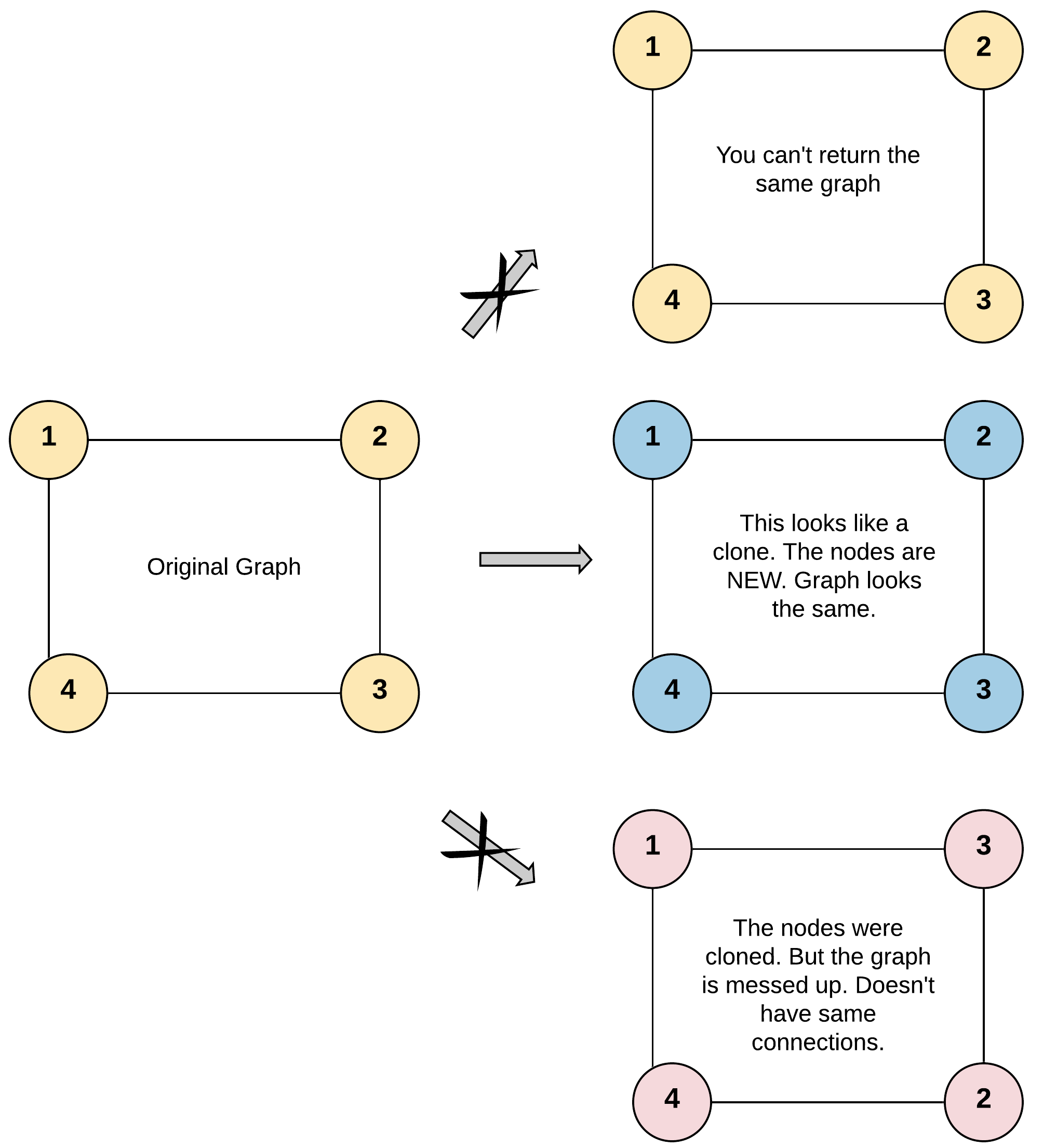
Input: adjList = [[2,4],[1,3],[2,4],[1,3]]
Output: [[2,4],[1,3],[2,4],[1,3]]
Explanation: There are 4 nodes in the graph.
1st node (val = 1)'s neighbors are 2nd node (val = 2) and 4th node (val = 4).
2nd node (val = 2)'s neighbors are 1st node (val = 1) and 3rd node (val = 3).
3rd node (val = 3)'s neighbors are 2nd node (val = 2) and 4th node (val = 4).
4th node (val = 4)'s neighbors are 1st node (val = 1) and 3rd node (val = 3).
Example 2:
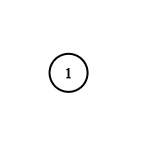
Input: adjList = [[]]
Output: [[]]
Explanation: Note that the input contains one empty list. The graph consists of only one node with val = 1 and it does not have any neighbors.
Example 3:
Input: adjList = []
Output: []
Explanation: This an empty graph, it does not have any nodes.
Constraints:
- The number of nodes in the graph is in the range
[0, 100]. 1 <= Node.val <= 100Node.valis unique for each node.- There are no repeated edges and no self-loops in the graph.
- The Graph is connected and all nodes can be visited starting from the given node.
"""
# Definition for a Node.
class Node:
    def __init__(self, val = 0, neighbors = None):
        self.val = val
        self.neighbors = neighbors if neighbors is not None else []
"""

from typing import Optional
class Solution:
    def cloneGraph(self, node: Optional['Node']) -> Optional['Node']:
        graph = {}

        def dfs(node) :
            if node in graph :
                return graph[node]

            nnode = Node(node.val)
            graph[node] = nnode

            for neighbor in node.neighbors :
                nnode.neighbors.append(dfs(neighbor))

            return nnode

        return dfs(node) if node else None
이 문제는 모르겠다. 조금 더 고민해보자.
'알고리즘 스터디' 카테고리의 다른 글
| [Leetcode/파이썬] 58. Length of Last Word (0) | 2026.03.14 |
|---|---|
| [Leetcode/파이썬] 222. Count Complete Tree Nodes (0) | 2026.03.07 |
| [Leetcode/파이썬] 202. Happy Number (0) | 2026.03.07 |
| [Leetcode/파이썬] 226. Invert Binary Tree (0) | 2026.03.07 |
| [Leetcode/파이썬] 103. Binary Tree Zigzag Level Order Traversal (0) | 2026.03.01 |