Construct Quad Tree

Given a n * n matrix grid of 0's and 1's only. We want to represent grid with a Quad-Tree.
Return the root of the Quad-Tree representing grid.
A Quad-Tree is a tree data structure in which each internal node has exactly four children. Besides, each node has two attributes:
val: True if the node represents a grid of 1's or False if the node represents a grid of 0's. Notice that you can assign thevalto True or False whenisLeafis False, and both are accepted in the answer.isLeaf: True if the node is a leaf node on the tree or False if the node has four children.
class Node {
    public boolean val;
    public boolean isLeaf;
    public Node topLeft;
    public Node topRight;
    public Node bottomLeft;
    public Node bottomRight;
}
We can construct a Quad-Tree from a two-dimensional area using the following steps:
- If the current grid has the same value (i.e all
1'sor all0's) setisLeafTrue and setvalto the value of the grid and set the four children to Null and stop. - If the current grid has different values, set
isLeafto False and setvalto any value and divide the current grid into four sub-grids as shown in the photo. - Recurse for each of the children with the proper sub-grid.

If you want to know more about the Quad-Tree, you can refer to the wiki.
Quad-Tree format:
You don't need to read this section for solving the problem. This is only if you want to understand the output format here. The output represents the serialized format of a Quad-Tree using level order traversal, where null signifies a path terminator where no node exists below.
It is very similar to the serialization of the binary tree. The only difference is that the node is represented as a list [isLeaf, val].
If the value of isLeaf or val is True we represent it as 1 in the list [isLeaf, val] and if the value of isLeaf or val is False we represent it as 0.
Example 1:

Input: grid = [[0,1],[1,0]]
Output: [[0,1],[1,0],[1,1],[1,1],[1,0]]
Explanation: The explanation of this example is shown below:
Notice that 0 represents False and 1 represents True in the photo representing the Quad-Tree.
Example 2:
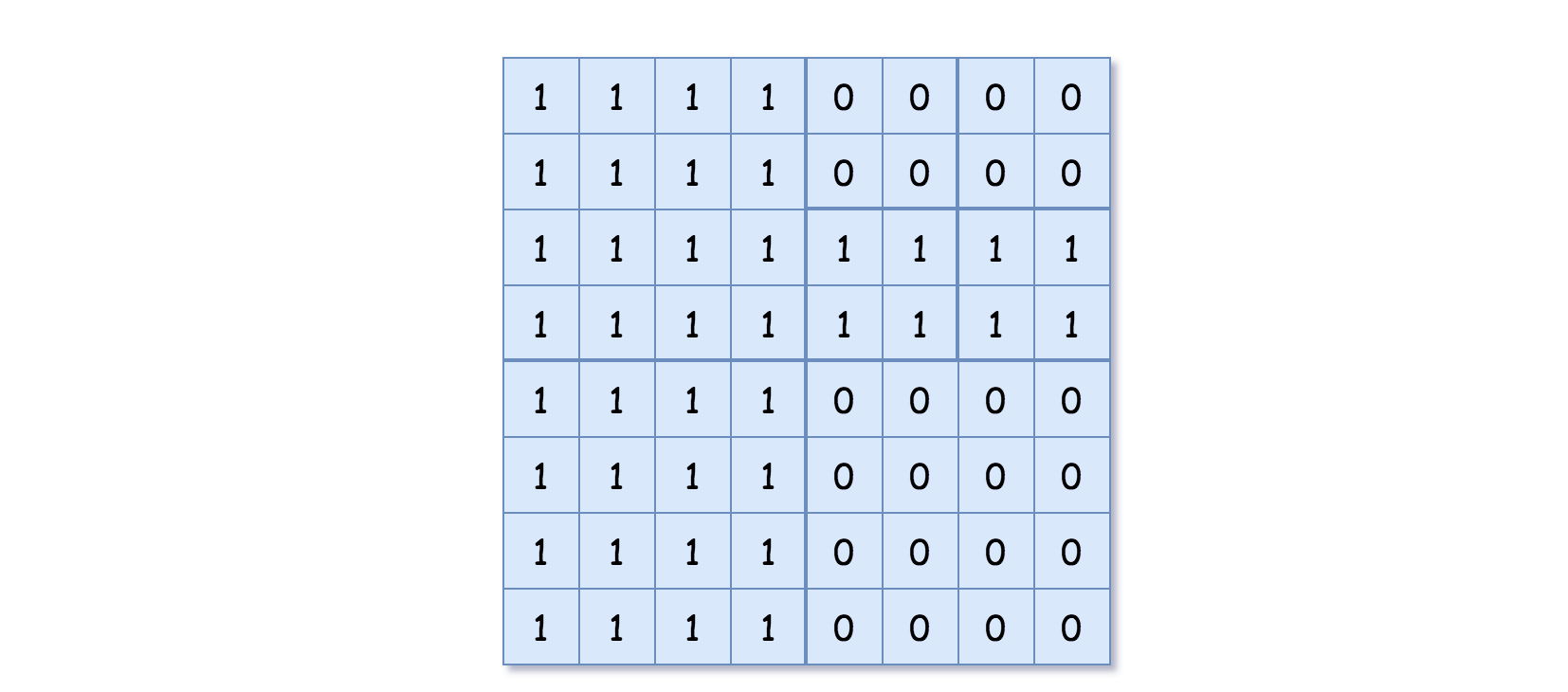
Input: grid =
[[1,1,1,1,0,0,0,0],
[1,1,1,1,0,0,0,0],
[1,1,1,1,1,1,1,1],
[1,1,1,1,1,1,1,1],
[1,1,1,1,0,0,0,0],
[1,1,1,1,0,0,0,0],
[1,1,1,1,0,0,0,0],
[1,1,1,1,0,0,0,0]]

Output: [[0,1],[1,1],[0,1],[1,1],[1,0],null,null,null,null,[1,0],[1,0],[1,1],[1,1]]
Explanation: All values in the grid are not the same. We divide the grid into four sub-grids.
The topLeft, bottomLeft and bottomRight each has the same value.
The topRight have different values so we divide it into 4 sub-grids where each has the same value.
Explanation is shown in the photo below:
Constraints:
n == grid.length == grid[i].lengthn == 2xwhere0 <= x <= 6
첫 번째 시도
from typing import *


# Definition for a QuadTree node.
class Node:
    def __init__(self, val, isLeaf, topLeft, topRight, bottomLeft, bottomRight):
        self.val = val
        self.isLeaf = isLeaf
        self.topLeft = topLeft
        self.topRight = topRight
        self.bottomLeft = bottomLeft
        self.bottomRight = bottomRight


class Solution:
    def construct(self, grid: List[List[int]]) -> 'Node':
        # isLeaf 는 말단이냐? 맞으면 1 아니면 0
        # 말단이 아니면 그냥 val은 1로 두는게 맞을듯? 1이랑 0이랑 섞여있으니까
        # 그럼 n을 계속 나눠가야겠네
        n = len(grid)
        res = self.checkLeaf(grid)

        return res
    def checkLeaf(self, grid : List[List[int]]) :
        n = len(grid)
        sm = 0

        for i in range(n) :
            for j in range(n) :
                sm += grid[i][j]

        if sm == n*n :
            return self.add_tree1(grid, Node(0, 0, None, None, None, None))
        elif sm == 0 :
            return self.add_tree2(grid, Node(0, 0, None, None, None, None))
        else :
            return self.add_tree3(grid, Node(0, 0, None, None, None, None))

    def add_tree1(self, grid: List[List[int]], node: "Node") :
        node.val = True
        node.isLeaf = True

        return node

    def add_tree2(self, grid: List[List[int]], node: "Node") :
        node.val = 0
        node.isLeaf = 1

        return node

    def add_tree3(self, grid: List[List[int]], node: "Node") :
        n = len(grid)
        node.val = 1
        node.isLeaf = 0
        node.topLeft = self.checkLeaf(grid[:n//2][:n//2])
        node.topRight = self.checkLeaf(grid[n//2 + 1:][:n//2])
        node.bottomLeft = self.checkLeaf(grid[:n//2][n//2+1:])
        node.bottomRight = self.checkLeaf(grid[n//2+1:][n//2+1:])

        return node
두 번째 시도
"""
# Definition for a QuadTree node.
class Node:
    def __init__(self, val, isLeaf, topLeft, topRight, bottomLeft, bottomRight):
        self.val = val
        self.isLeaf = isLeaf
        self.topLeft = topLeft
        self.topRight = topRight
        self.bottomLeft = bottomLeft
        self.bottomRight = bottomRight
"""

class Solution:
    def construct(self, grid: List[List[int]]) -> 'Node':
        # Node : val, isLeaf, topLeft, topRight, bottomLeft, bottomRight
        node = Node(False, True, None, None, None, None)
        n = len(grid)
        if n == 1 :
            node.val = True if grid[0][0] == 1 else False
            return node

        return self.my_construct(grid, 0, 0, n)

    def my_construct(self, grid : List[List[int]], sr, sc, delta) :
        one, zero = False, False

        for row in grid[sr:sr+delta] :
            col = row[sc:sc+delta]
            for local_v in col :
                if local_v == 0 :
                    zero |= True
                else :
                    one |= True

        # 0 으로만 구성됨
        if one == False and zero == True :
            return Node(False, True, None, None, None, None)

        # 1 로만 구성됨
        if one == True and zero == False :
            return Node(True, True, None, None, None, None)

        return Node(True, False,
                    self.my_construct(grid, sr, sc, delta//2),
                    self.my_construct(grid, sr, sc + delta//2, delta//2),
                    self.my_construct(grid, sr+delta//2, sc, delta//2),
                    self.my_construct(grid, sr+delta//2, sc+delta//2, delta//2),)
세 번째 시도
"""
# Definition for a QuadTree node.
class Node:
    def __init__(self, val, isLeaf, topLeft, topRight, bottomLeft, bottomRight):
        self.val = val
        self.isLeaf = isLeaf
        self.topLeft = topLeft
        self.topRight = topRight
        self.bottomLeft = bottomLeft
        self.bottomRight = bottomRight
"""

class Solution:
    def construct(self, grid: List[List[int]]) -> 'Node':
        # Node : val, isLeaf, topLeft, topRight, bottomLeft, bottomRight
        node = Node(False, True, None, None, None, None)
        n = len(grid)
        if n == 1 :
            node.val = True if grid[0][0] == 1 else False
            return node

        return self.checkLeaf(grid, 0, 0, n)

    def checkLeaf(self, grid : List[List[int]], sr: int, sc: int, leng: int) :
        sm = 0

        for row in grid[sr:sr+leng] :
            col = row[sc:sc+leng]
            for v in col :
                sm += v

        # 1로만 구성됨
        if sm == leng * leng:
            return Node(True, True, None, None, None, None)
        # 0으로만 구성됨
        elif sm == 0 :
            return Node(False, True, None, None, None, None)
        else :
            return Node(True, False,
                        self.checkLeaf(grid, sr, sc, leng//2),
                        self.checkLeaf(grid, sr, sc+leng//2, leng//2),
                        self.checkLeaf(grid, sr+leng//2, sc, leng//2),
                        self.checkLeaf(grid, sr+leng//2, sc+leng//2,leng//2),)
나중에 코데풀님이 설명해주시겠지...
첫 번째 시도는 순수 내 머리로 만든 코드 : 아 슬라이싱을 이용해서 풀어야 겠다. 근데 프린트 해보니까 슬라이싱이 전혀 되지 않음, 행으로는 잘리는데 열로 안 잘림.
두 번째 시도 : 코데풀님 코드 참고 => 슬라이싱 방법 체득
세 번째 시도 : 내 코드 + 코데풀님 슬라이싱 방법 채용 : 잘 풀렸음...
더 디테일한 부분에서 수정이 필요하겠지만, 이따 스터디때 자세하게 물어보자.
'알고리즘 스터디' 카테고리의 다른 글
| [Leetcode/파이썬] 169. Majority Element (0) | 2026.03.29 |
|---|---|
| [Leetcode/파이썬] 14. Longest Common Prefix (0) | 2026.03.29 |
| [Leetcode/파이썬] 77. Combinations (0) | 2026.03.22 |
| [Leetcode/파이썬] 205. Isomorphic Strings (0) | 2026.03.22 |
| [Leetcode/파이썬] 105. Construct Binary Tree from Preorder and Inorder Traversal (0) | 2026.03.22 |